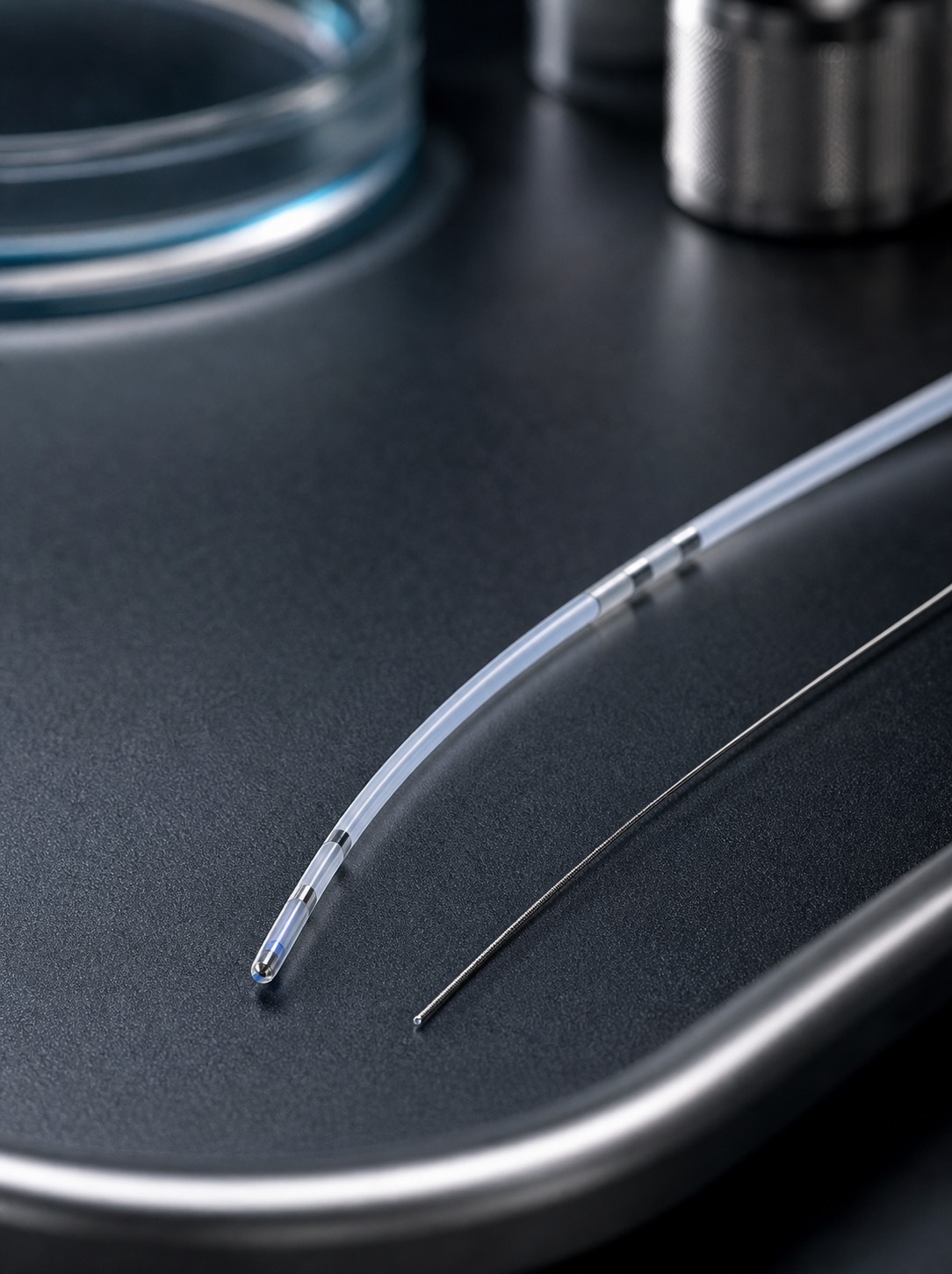
Create a deliberate stiffness profile
Proximal support, mid-shaft navigation and distal softness must transition without abrupt mechanical discontinuities. Reinforcement pitch, wire geometry, jacket segments and overlap lengths all contribute.
Treat friction and geometry together
Trackability depends on more than flexibility. Surface interaction, inner-lumen friction, outer diameter, tortuosity and compatibility with guidewires or devices must be assessed as a system.
Verify performance in relevant models
Bench models should represent the intended anatomy and use sequence. Force, torque, kink, tensile and dimensional testing should connect back to defined use conditions.
A useful next step
Share a non-confidential summary of the application, development stage, current architecture and most important uncertainty. From there, the appropriate review, analysis or training scope can be identified.
This content is educational and is not medical advice or a substitute for applicable quality and regulatory requirements.