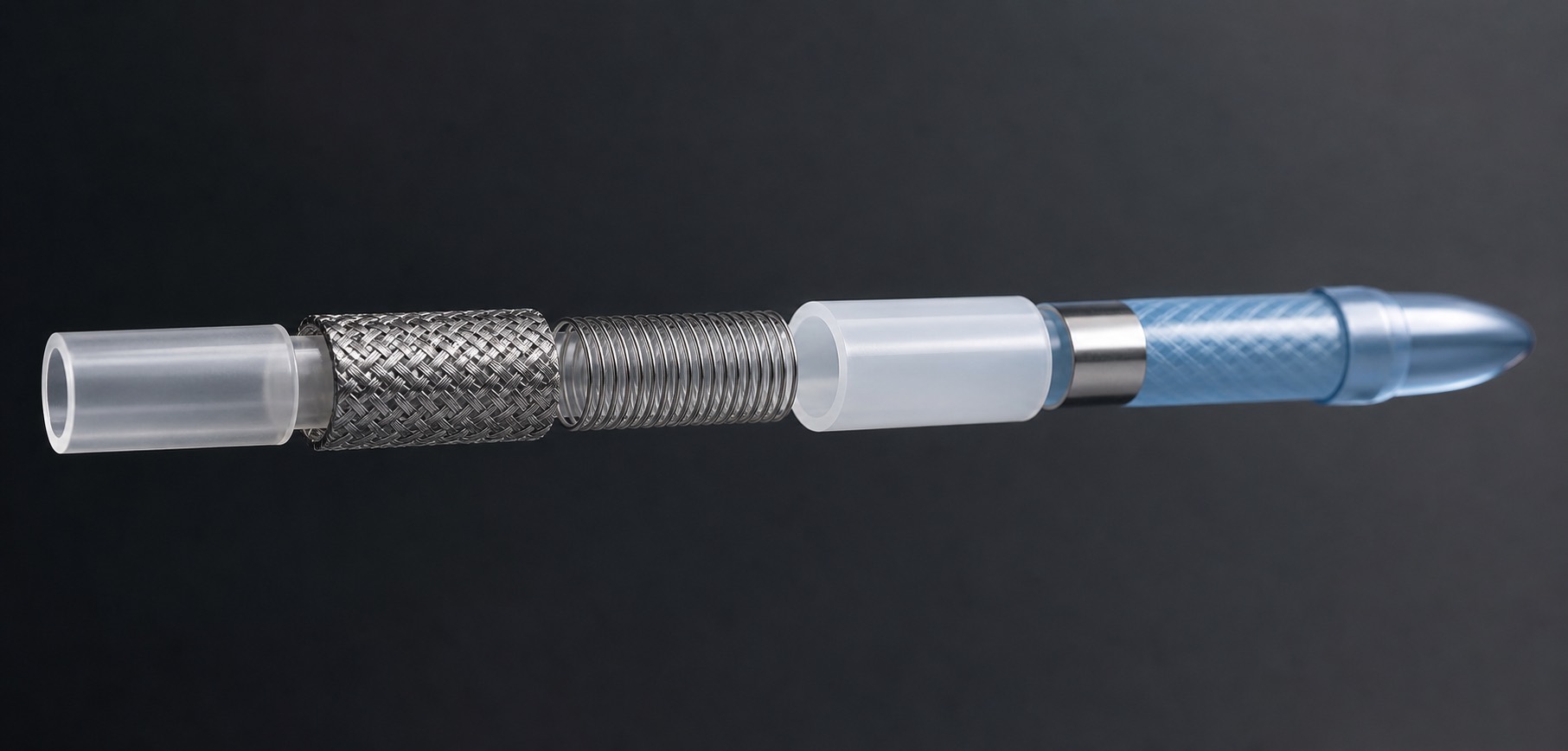
The liner sets the lumen interface
Liner material and thickness influence friction, device compatibility, processing temperature and available wall budget. It must survive subsequent reinforcement and reflow operations.
Reinforcement transfers load
Braid can support torque and radial stability; coil can support kink resistance and flexibility; laser-cut structures can create controlled features. Geometry and termination strategy matter as much as material.
The jacket shapes the stiffness profile
Jacket durometer, wall distribution and segment transitions influence bending, pushability and recovery. Reflow conditions also affect liner integrity and reinforcement position.
Transitions deserve explicit design
Abrupt changes in modulus, reinforcement or wall thickness concentrate strain. Overlaps, tapers and process control should create intentional load transfer.
The distal tip completes the system
Tip softness, geometry, radiopacity and bond design must support atraumatic navigation without sacrificing integrity or visibility.
A useful next step
Share a non-confidential summary of the application, development stage, current architecture and most important uncertainty. From there, the appropriate review, analysis or training scope can be identified.
This content is educational and is not medical advice or a substitute for applicable quality and regulatory requirements.