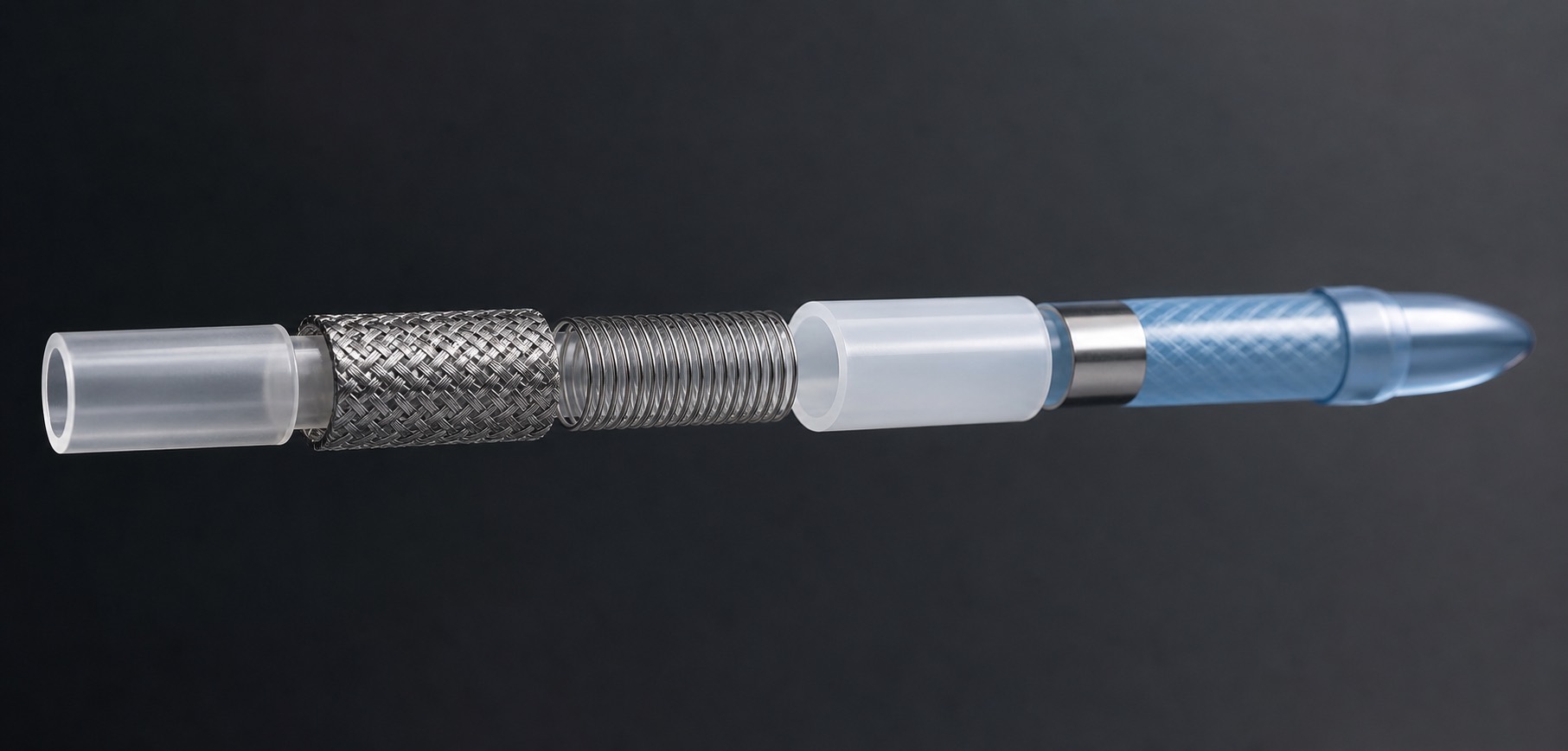
Start with use conditions, not a material list
Architecture begins with anatomy, access path, device compatibility, procedure workflow and measurable performance needs. Those inputs guide diameter, working length, lumen count, shaft regions, reinforcement and distal geometry.
Design the shaft as a system
Liner friction, reinforcement density, jacket modulus, wall thickness and thermal processing interact. A change that improves pushability may reduce trackability or raise kink risk, so tradeoffs need to be evaluated together.
Build learning into prototypes
Early builds should answer specific questions. A structured prototype matrix, documented build conditions and focused bench tests produce more useful learning than repeated one-off samples.
A useful next step
Share a non-confidential summary of the application, development stage, current architecture and most important uncertainty. From there, the appropriate review, analysis or training scope can be identified.
This content is educational and is not medical advice or a substitute for applicable quality and regulatory requirements.