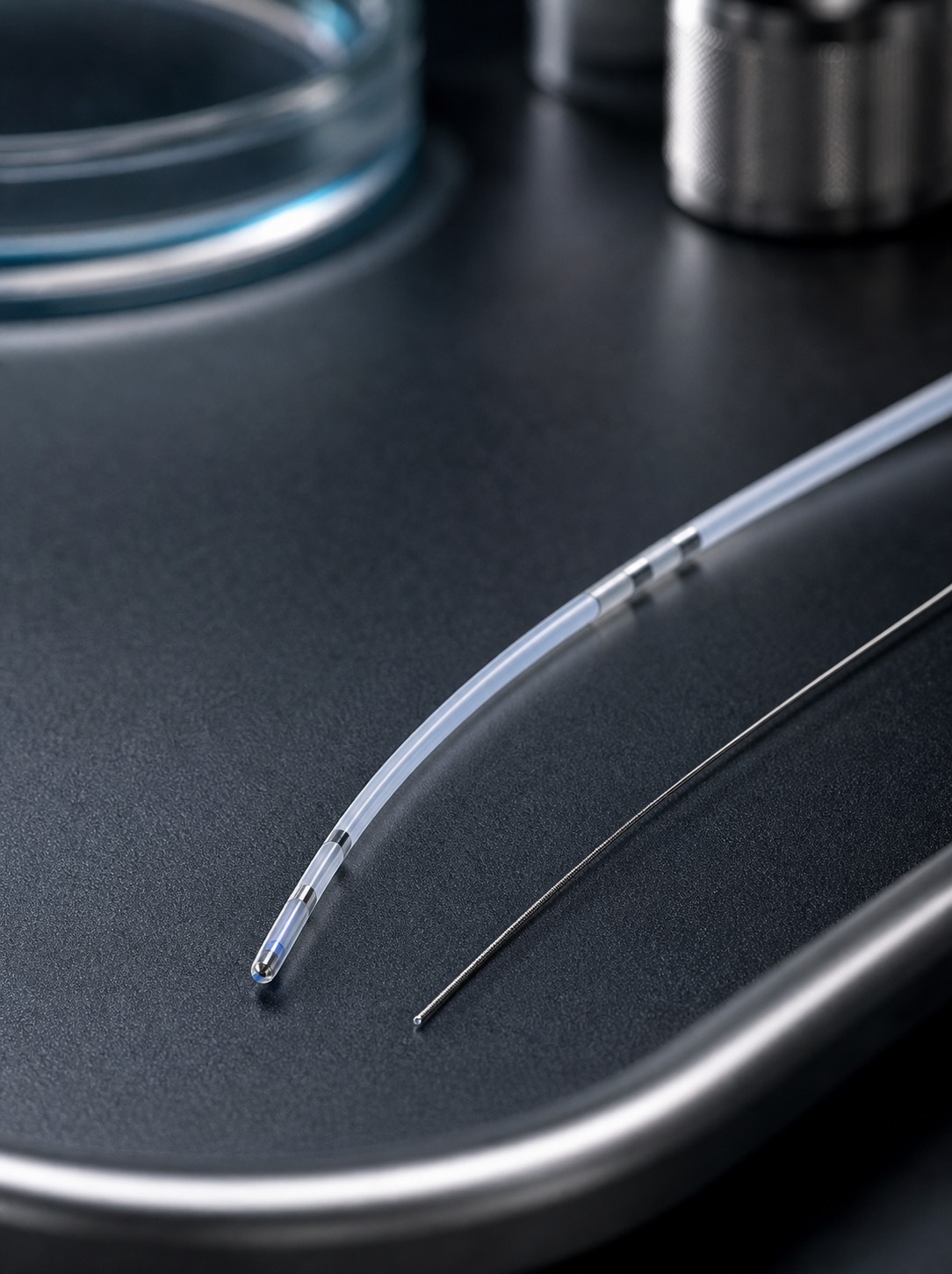
Trackability is system behavior
Distal flexibility helps, but friction, support, geometry and transition quality determine whether the catheter follows a guidewire through tortuous paths.
Support must be placed deliberately
Proximal push and rotational response must reach the distal region without causing buckling or vessel-loading concerns. The correct balance depends on the use sequence.
Transitions often control failure
Reinforcement endings and material changes can produce hinge points, ovalization or localized strain. Smooth mechanical transitions are central to reliable navigation.
Models must represent use
Anatomical models, guidewires, devices, temperature, hydration and operator technique should be selected to answer defined performance questions.
A useful next step
Share a non-confidential summary of the application, development stage, current architecture and most important uncertainty. From there, the appropriate review, analysis or training scope can be identified.
This content is educational and is not medical advice or a substitute for applicable quality and regulatory requirements.